

3D Animation Production & 3D Explainer Videos
3D animation production is the work of building a film in three-dimensional digital space: modelling objects, characters and environments, then lighting, animating and rendering them into finished video. Animation Explainers produces custom 3D explainer videos and 3D animation for technology, industrial, medical and B2B companies, from the script to the final render.
Projects typically run from $6,000 to $35,000+ and take 4–6 weeks, with three rounds of revisions and full rights to the finished film.
3D explainer videos for things that are hard to show
3D is at its best when the subject is physical, hidden or too complex to film: the inside of a machine, a robot picking parts from a bin, a device inside the body, a data centre, a ship crossing an ocean of data. The camera can go anywhere, at any scale, and every surface, light and movement is under control.
A 3D explainer video uses that to make one idea understood in about 60 to 120 seconds. The script decides what the viewer must understand; the 3D world exists to show it as clearly as possible.
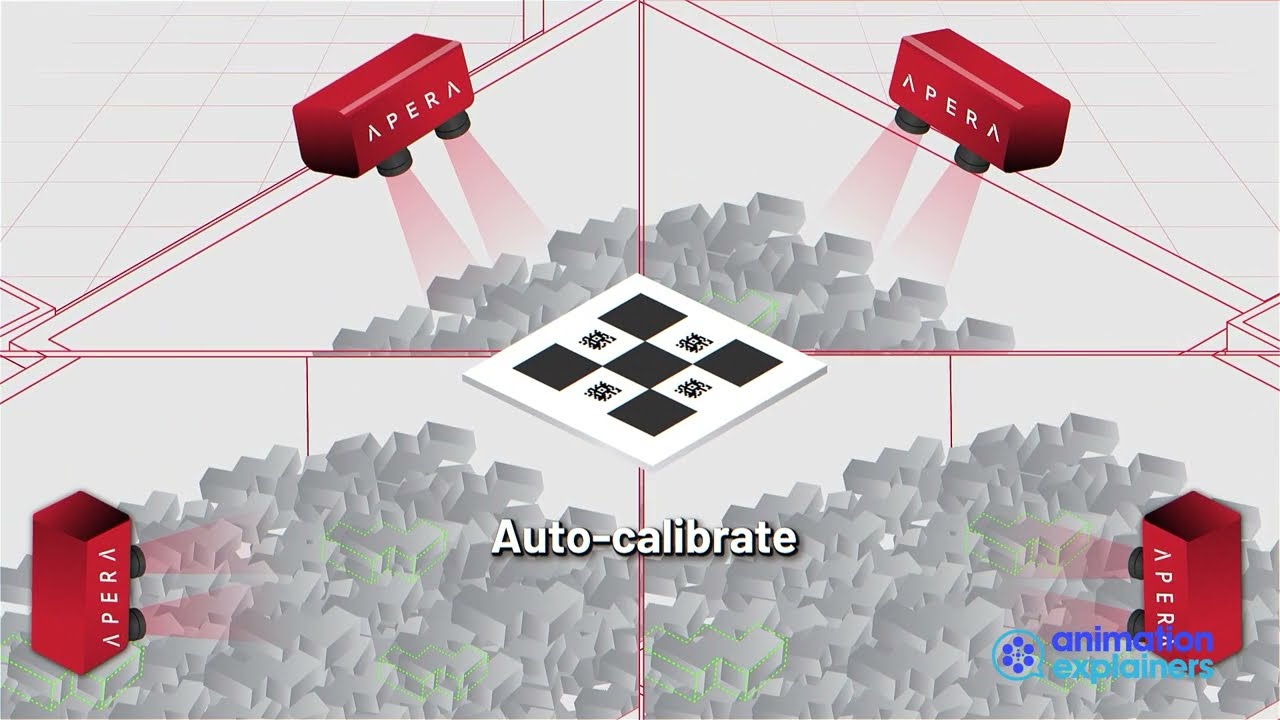
Apera AI: a robot cell, built in 3D. A turnkey cell that picks parts straight from a bin, however they land, and loads them into a fixture. The robot, the bin and the set-up steps are modelled in 3D so the viewer can see exactly how the system works from every angle.
When to choose 3D
Choose 3D animation when:
- The product is physical and its shape, parts or movement are the story
- The action is hidden: inside a machine, a body, a network or a building
- Scale matters: from a component to a factory, or from a cell to a patient
- You need realism or premium polish for a launch, an investor meeting or a trade show
- You'll reuse the assets: the same models can make product stills, short loops, training clips and future films
Choose something simpler when the story is about people, software screens or abstract ideas. 2D explainer videos and motion graphics often explain those faster and for less. Many of our films mix 3D objects with 2D graphics.
| Your film is mostly about… | Best fit |
| A machine, device, robot or physical product | 3D animation |
| A process inside the body or a mechanism of action | 3D, see medical animation |
| Customers, staff and everyday situations | 2D explainer videos |
| Software, data and dashboards | Motion graphics, sometimes with 3D elements |
| A step-by-step idea drawn as it’s explained | Whiteboard |
For every style side by side, see types of animation styles.
Apera AI: why robotic vision struggles, and what changes. The film contrasts traditional robotic vision, with its flashing lights, scanning and 3D point clouds, with an AI approach, then pulls back to a full 3D factory. It shows how 3D can explain both a technical problem and its solution.
Types of 3D animation we produce
| Type | What it shows | Typical length |
| 3D explainer video | How a product, system or process works, with voiceover | 60–120 seconds |
| Technical and industrial animation | Machines, robots, production lines and plants in operation | 60–120 seconds |
| Medical and device animation | Devices, procedures and mechanisms inside the body | 60–180 seconds |
| 3D product animation | A product’s design and features for launches and ads; see 3D product animation | 15–60 seconds |
| Data and infrastructure visualisation | Networks, data centres, cyber threats and energy systems | 60–120 seconds |
| Training and instructions | Assembly, set-up, use and maintenance, step by step | 1–3 minutes, or a series |
| Trade show and sales loops | Silent, looping 3D sequences for screens and tablets | 20–60 seconds |
| 3D characters | A mascot or guide character built and rigged in 3D | Any |
ZeroNorth: a global industry on a 3D globe. A stylised 3D globe and data shapes set up the scale of shipping and its data, before the story moves to a single vessel. It’s a good example of 3D used to show something too big to film.
3D animation from our studio
Intel 471: cyber threats as a 3D city. A neon 3D city and server halls turn invisible cyber threats into a world the viewer can move through, giving a security product a cinematic, high-stakes tone. See also cybersecurity explainer videos.
More 3D work on our YouTube channel:
| Client | What the 3D shows | Length |
| F Street | Low-poly 3D trees, charts and a city block on white plinths, for a 30-second financial film | 0:31 |
| Siren | Dark, dimensional tech graphics: logo, code and network scenes | 2:10 |
Everything else is on our portfolio. Animation Explainers is a Fall 2026 Clutch Global Winner.
What goes into 3D animation production
Every 3D film passes through the same production stages. You don’t need to manage them, but knowing them explains where the time and budget go:
| Stage | What happens | Why it matters to you |
| Modelling | Objects, characters and environments are built as 3D meshes, from your CAD files, photos or our designs | Accurate models are reused across every scene and future film |
| Texturing and materials | Colour, surface and finish are applied: metal, plastic, glass, skin | Decides how real or how stylised the film looks |
| Rigging | Moving parts and characters get controls, like a skeleton | Lets mechanisms and characters move believably (see the 12 principles of animation and walk cycle animation) |
| Layout and animation | Cameras are placed and every movement is keyed to the voiceover | Where the story is told |
| Lighting | Virtual lights set the mood and make shapes read clearly | Separates premium 3D from flat 3D |
| Rendering | The computer calculates every frame, often in layers | The most machine-heavy stage; changes after it cost the most |
| Compositing and sound | Layers, effects, 2D graphics, colour, music and sound design come together | The finished look and feel |
That’s why approvals happen early: the script, the storyboard and the look are signed off before rendering, when changes are still cheap. The craft has come a long way; see the history of 3D animation.
Highpoint: a device shown working inside the body. The film opens on the patient’s problem, then moves into a 3D sequence of a treatment device inside the nasal tissue, with an on-screen disclaimer that the activation sequence is indicative only. See also medical device animation.
How we make a 3D explainer video
- Discovery call. We learn the product, the audience, the one thing they must understand and where the film will play, then send a short creative brief.
- Reference pack. You share CAD files, photos, drawings, product samples or technical documents. Where there’s no CAD, we model from references.
- Script. We write the voiceover and on-screen words. More on how to write a video script.
- Style frames and storyboard. Finished-look 3D frames set the materials, lighting and level of realism, then a storyboard shows every scene before animation starts.
- Voiceover. You choose a professional voice in the accent and language you need. See explainer video voiceover.
- Modelling and animation. We build the models, then animate each scene to the approved storyboard and voice, with preview renders for your review.
- Final render, sound and delivery. We render, composite, add music and sound design, and deliver the master and every agreed version.
Every project includes three rounds of revisions, one at each stage: script, storyboard and animation. You own the rights to the finished film. The full walkthrough is in our explainer video production process.
Week by week for a 60 to 90 second 3D explainer:
| Week | What happens | Your part |
| 1 | Kick-off meeting, creative brief, first script draft | Join the kick-off, send brand assets, approve the brief |
| 2 | Script revisions, then storyboard and style frames begin | Sign off the script (round 1) |
| 3 | Storyboard and style frames finished, voice casting | Sign off the board and style (round 2), pick a voice |
| 4 | Voiceover recorded, music chosen, animation starts | Approve the read and the music |
| 5 | Animation and sound design | Nothing, unless we have a question |
| 6 | Full draft cut, final changes, exports and delivery | Give round 3 feedback, then approve the final |
What you get
| Deliverable | Detail |
| Creative brief | Goal, audience, key message and call to action agreed in writing |
| Script | Voiceover and on-screen words, approved before design starts |
| 3D style frames and storyboard | The look, the level of realism and every scene, before animation starts |
| Custom 3D models | Built for your product and film from your CAD or references |
| 3D animation and render | Lit, animated and rendered to the approved storyboard |
| Professional voiceover | Casting, direction and recording; other languages on request |
| Music and sound design | Licensed music and sound effects |
| Revisions | Three rounds, one each at script, storyboard and animation |
| Rights | You own the rights to the finished film |
| Delivery files | Full-HD master, cutdowns, silent loops, captions and the aspect ratios each channel needs |
How much does 3D animation production cost?
| Cost and timeline | 3D animation at Animation Explainers |
| Typical project budget | $6,000–$35,000+, quoted against your brief |
| Stylised 3D or 3D mixed with 2D | Lower to middle of the band for a focused 60–90 second film |
| Detailed or photoreal 3D | Toward the top of the band and above, depending on models, materials and scenes |
| Production timeline | 4–6 weeks for a 60–90 second film, from brief to delivery |
| What sets the pace | How quickly script, storyboard and style frames are approved, and whether CAD is ready |
| Revisions | Three rounds, one per stage |
| Rights | You own the finished film |
Projects at Animation Explainers typically run from $6,000 to $35,000+. Where yours lands depends on:
- Models: how many objects and environments need building, and whether CAD exists
- Realism: stylised, clean-technical or photoreal materials and lighting
- Length of the film and the number of distinct scenes
- Characters: rigged 3D characters take more time than objects and cameras
- Versions: languages, cutdowns, loops and aspect ratios
- One film or a series: models built once make every extra film quicker to produce
Full breakdown: our explainer video cost guide. For a scoped number, book a call.
How long should a 3D explainer video be?
| Use | Typical length |
| Homepage or product page | 60 to 90 seconds |
| Technical or “how it works” film | 90 seconds to 2 minutes |
| Investor or launch film | 60 to 120 seconds |
| Training or instructions | Short chapters of 1 to 2 minutes each |
| Trade show loop | 20 to 60 seconds, silent, with on-screen words |
| Ads and social | 15 to 30 seconds, cut from the master |
More on explainer video length.
Industries we make 3D animation for
| Industry | Typical 3D films |
| Manufacturing and robotics | Robot cells, machines, production lines, assembly |
| Medical devices and healthcare | Devices, procedures, anatomy; see medical device animation and medical animation |
| Pharma and biotech | Mechanisms of action and patient films; see pharmaceutical animation |
| Technology and AI | Hardware, sensors and AI systems; see AI explainer videos |
| Cybersecurity and data | Networks, data centres and threats as navigable 3D worlds |
| Energy and utilities | Plants, grids, monitoring equipment |
| Shipping and logistics | Vessels, fleets, warehouses and supply chains |
| Engineering and construction | Buildings, infrastructure and site processes |
| Consumer products | Launch films and features; see 3D product animation |
For internal learning, see training videos.
What clients say
Integrated Protection Group (security programmes): “On LinkedIn, we received a tremendous response to the video. … That was by far the best response we’ve gotten on LinkedIn.”
Procare Solutions (child care management software): “We’ve seen a remarkable rise in traffic on the pages that have videos on them. … Their videos have performed a lot better than other videos we’ve released in the past.”
More results, in the clients’ own words, on our explainer video company page.
FAQ
What is a 3D explainer video?
A 3D explainer video is a short animated film, usually 60 to 120 seconds, that uses 3D models, environments and camera moves to show how a product, system or process works, with a voiceover that explains it.
What does 3D animation production include?
Script, storyboard, 3D modelling, texturing, rigging, animation, lighting, rendering, compositing, voiceover, music and sound design, plus the delivery files you need.
How much does 3D animation production cost?
Projects at Animation Explainers typically run from $6,000 to $35,000+. Stylised 3D sits lower in the band; detailed or photoreal 3D with many models and scenes sits toward the top. We quote against your brief after a call.
How long does it take to make a 3D explainer video?
Production takes 4–6 weeks for a 60–90 second film, from brief to delivery. The pace depends on approvals and on whether CAD files are ready.
Is 3D animation more expensive than 2D?
Usually, because models, materials, lighting and rendering add work. A stylised 3D film or a mix of 3D objects with 2D graphics can keep costs close to a detailed 2D film.
When should I choose 3D over 2D?
When the subject is physical, hidden from view or needs realism: machines, devices, robots, infrastructure or anatomy. For stories about people or software screens, 2D or motion graphics is often faster and cheaper.
Can you work from our CAD files?
Yes. CAD files in common formats speed up modelling and keep the product accurate. Where there’s no CAD, we model from photos, drawings and samples.
Do you need a physical product to make a 3D animation?
No. Photos, drawings, technical documents or CAD are enough. A sample helps with materials and finishes, but isn’t required.
Can 3D animation show something that doesn’t exist yet?
Yes. 3D is often used before a product is manufactured or a site is built, for investors, pre-orders and launches.
Can you combine 3D with 2D or motion graphics?
Yes. Many of our films mix 3D objects with 2D characters, interface graphics or on-screen text, which keeps the film clear and the budget in check.
Can you make 3D characters?
Yes. We design, model and rig 3D characters and mascots. Character animation takes longer than objects and camera moves, so it’s scoped up front.
What’s the difference between a 3D explainer video and a 3D product animation?
A 3D explainer video explains how something works, with a voiceover and a story. A 3D product animation shows off a product’s design and features, usually shorter and built for launches and ads. See our 3D product animation page.
Can you make medical and device animations in 3D?
Yes. 3D is well suited to devices, procedures and anatomy. See medical animation and pharmaceutical animation.
Can the 3D models be reused?
Yes. Once built, the models can make product stills, trade show loops, training clips and future films, which makes every extra asset quicker to produce.
What files do you deliver?
A full-HD master plus the agreed versions: cutdowns, silent loops, captions and the aspect ratios each channel needs. Other formats can be agreed at the start.
Can the video be made in other languages?
Yes. We can record voiceovers and add captions in other languages, and design on-screen text so it’s easy to translate.
How many revisions are included?
Three rounds of revisions, one at each stage: script, storyboard and animation. Because rendering is the costliest stage, the look is agreed before it starts.
Who owns the finished 3D animation?
You do. You own the rights to the finished film and can use it on your website, in sales, at events and in ads.
What do you need from us to get started?
A discovery call, any CAD files, photos or technical documents, brand guidelines, and a single person to collect your team’s feedback.
How do we start?
Book a call. We’ll talk through your product and audience, then send a scoped quote and timeline. Book a call.
Start your 3D animation
Tell us what you need to show and who needs to understand it. We’ll come back with a creative approach, a price and a timeline. Book a call.

What is a 3D explainer video?
A 3D explainer video is a short animated film, usually 60 to 120 seconds, that uses 3D models, environments and camera moves to show how a product, system or process works, with a voiceover that explains it.
What does 3D animation production include?
Script, storyboard, 3D modelling, texturing, rigging, animation, lighting, rendering, compositing, voiceover, music and sound design, plus the delivery files you need.
How much does 3D animation production cost?
Projects at Animation Explainers typically run from $6,000 to $35,000+. Stylised 3D sits lower in the band; detailed or photoreal 3D with many models and scenes sits toward the top. We quote against your brief after a call.
How long does it take to make a 3D explainer video?
Production takes 4–6 weeks for a 60–90 second film, from brief to delivery. The pace depends on approvals and on whether CAD files are ready.
Is 3D animation more expensive than 2D?
Usually, because models, materials, lighting and rendering add work. A stylised 3D film or a mix of 3D objects with 2D graphics can keep costs close to a detailed 2D film.
When should I choose 3D over 2D?
When the subject is physical, hidden from view or needs realism: machines, devices, robots, infrastructure or anatomy. For stories about people or software screens, 2D or motion graphics is often faster and cheaper.
Can you work from our CAD files?
Yes. CAD files in common formats speed up modelling and keep the product accurate. Where there’s no CAD, we model from photos, drawings and samples.
Do you need a physical product to make a 3D animation?
No. Photos, drawings, technical documents or CAD are enough. A sample helps with materials and finishes, but isn’t required.
Can 3D animation show something that doesn’t exist yet?
Yes. 3D is often used before a product is manufactured or a site is built, for investors, pre-orders and launches.
Can you combine 3D with 2D or motion graphics?
Yes. Many of our films mix 3D objects with 2D characters, interface graphics or on-screen text, which keeps the film clear and the budget in check.
Can you make 3D characters?
Yes. We design, model and rig 3D characters and mascots. Character animation takes longer than objects and camera moves, so it’s scoped up front.
What’s the difference between a 3D explainer video and a 3D product animation?
A 3D explainer video explains how something works, with a voiceover and a story. A 3D product animation shows off a product’s design and features, usually shorter and built for launches and ads. See our 3D product animation page.
Can you make medical and device animations in 3D?
Yes. 3D is well suited to devices, procedures and anatomy. See medical animation and pharmaceutical animation.
Can the 3D models be reused?
Yes. Once built, the models can make product stills, trade show loops, training clips and future films, which makes every extra asset quicker to produce.
What files do you deliver?
A full-HD master plus the agreed versions: cutdowns, silent loops, captions and the aspect ratios each channel needs. Other formats can be agreed at the start.
Can the video be made in other languages?
Yes. We can record voiceovers and add captions in other languages, and design on-screen text so it’s easy to translate.
How many revisions are included?
Three rounds of revisions, one at each stage: script, storyboard and animation. Because rendering is the costliest stage, the look is agreed before it starts.
Who owns the finished 3D animation?
You do. You own the rights to the finished film and can use it on your website, in sales, at events and in ads.
What do you need from us to get started?
A discovery call, any CAD files, photos or technical documents, brand guidelines, and a single person to collect your team’s feedback.
How do we start?
Book a call. We’ll talk through your product and audience, then send a scoped quote and timeline. Book a call.